
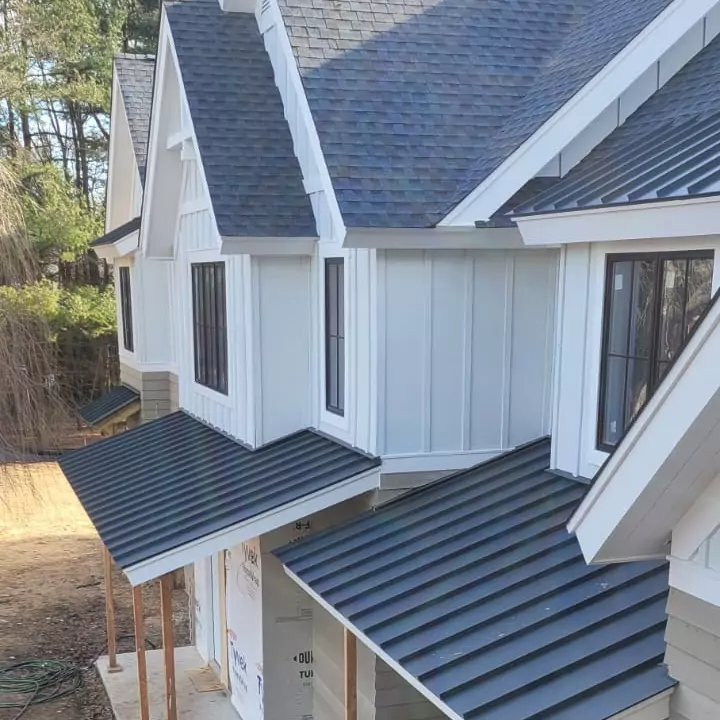
Bayside, Queens is where REVMA keeps its yard. Our trucks leave 23rd Avenue every morning, which means a roof replacement in Bayside, Bay Terrace or Oakland Gardens is the shortest trip we make and the one we know best, block by block. This guide covers what actually shapes a Bayside roof job: the houses, the permit process, the weather off Little Neck Bay, and the material choices that make sense here.
What Bayside roofs look like
Most of Bayside was built out between the 1920s and the 1960s, and the roofs follow that timeline. The older blocks near Bell Boulevard and toward Crocheron Park carry Colonials and Tudors with steep pitches, dormers and, on a fair number of them, original slate or cedar. The postwar streets in Oakland Gardens and around Alley Pond are Capes and split-levels with simpler geometry and asphalt shingle roofs that have usually been replaced at least once already. Bay Terrace adds a third category: garden apartment co-ops with low-slope roofs that behave more like a commercial membrane job than a house.
That mix matters because the three roof types call for different crews, different materials and different pricing. A steep Tudor with three dormers and a slate valley is not the same job as a Cape with two planes and a chimney, and we quote them differently rather than pricing by the square and hoping the details work out.
Permits: NYC Department of Buildings
Bayside is New York City, so a full tear-off and replacement goes through the Department of Buildings and is filed in DOB NOW. The contractor on record has to hold a current NYC license and carry the insurance the city requires. Some minor repairs fall under the department's rules for work that does not need a permit, but a replacement of the whole roof does not, and a contractor who tells you otherwise is asking you to carry the risk.
We file the paperwork ourselves. The homeowner signs where the homeowner has to sign, and the rest is our problem. If you want to see how that fits into the overall process, the residential roofing page walks through it step by step.
Wind off Little Neck Bay
Bayside sits on the western shore of Little Neck Bay, and the streets north of Northern Boulevard take sustained wind off the water. Most wind damage on a shingle roof starts at the edge: the starter course lifts, the first full course follows, and the failure walks up the slope from there. On Bayside jobs we upgrade the perimeter rather than the field. That means a proper starter strip at the eaves and rakes, a high-wind nailing pattern on the first courses, and a drip edge that is actually fastened through the deck, not tacked to the fascia.
Inland Bayside, south of the Long Island Expressway, is more sheltered. There the more common problem is leaf load from the mature street trees, which packs the valleys and slows drainage. If your roof has a north-facing valley under a big oak, that is where the slow leak will show up first, and it is worth a professional inspection before it becomes a ceiling stain.
Materials that make sense in Bayside
For most Bayside homes the answer is an architectural asphalt shingle. GAF Timberline HDZ and Owens Corning Duration are the two lines we install most here, and both carry wind ratings that are appropriate for the waterfront blocks when installed with the manufacturer's high-wind detailing. On the older Tudors and Colonials we see three other paths:
- Natural cedar. A number of Bayside and Douglaston homes still carry their original cedar shingles. Replacing in kind with western red cedar keeps the house looking the way it was designed to look.
- Natural slate. If the original slate is still there, it is often worth restoring the flashings and replacing individual pieces rather than tearing off a roof that could last another fifty years. We will tell you which you have.
- Composite. DaVinci and Brava give the look of slate or shake at a weight the original framing can carry without reinforcement, which is the practical answer on a lot of 1920s houses.
The Bay Terrace co-ops are a different conversation. Those roofs are low-slope and get an EPDM or modified bitumen system, and the board usually wants a spec and a warranty rather than a color sample. Our flat roof page covers the systems we install there.
The practical side: driveways, dumpsters and neighbors
Bayside driveways are narrow. A lot of them will not take a full-size container, and a few will not take a container at all without blocking the sidewalk. We look at this before we quote, because where the debris goes affects how the job is staged and how long it takes. On attached and semi-attached homes near Bell Boulevard we also let the neighbor know before the tear-off starts. It is a courtesy, and it heads off the phone call to 311.
Gutters come up on nearly every Bayside replacement. The tear-off disturbs the hangers, the fascia behind the gutter is usually the first wood to rot, and a new roof with a new drip edge often exposes how tired the old gutters were. We address the gutters as part of the roof scope rather than leaving them for later. There is a fuller explanation in our guide to replacing gutters with your roof.
How long a Bayside roof replacement takes
A straightforward Cape or split-level is usually a one or two day job for a full crew. A steep Tudor with dormers, a slate valley to rebuild and copper flashing at the chimney takes longer, and the permit lead time sits in front of either. We schedule around weather, and we do not open more roof in a day than we can dry in that day.
Getting a roof estimate in Bayside
REVMA is based at 215-30 23rd Avenue in Bayside, licensed by the NYC Department of Consumer and Worker Protection as a Home Improvement Contractor (2126882-DCWP), and insured. We look at the roof in person before we price it. Call (646) 889-4529 or request an estimate, and if you want to see how we approach the rest of the borough, start with our Queens roofing page.