
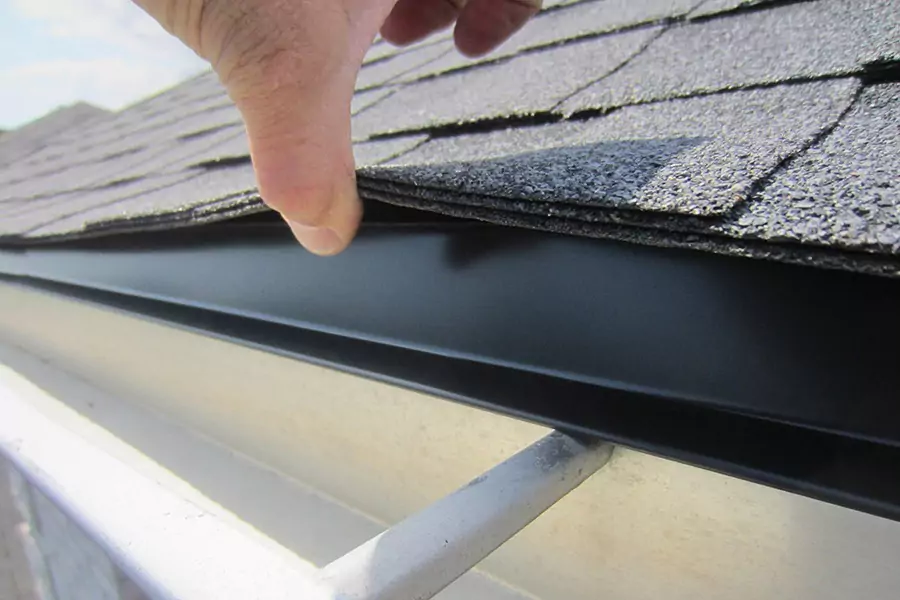
Almost every homeowner in Queens and Nassau County asks the same question during a roof replacement estimate: do the gutters need to go too? The short answer is that they usually should, and not because a contractor wants to sell you more. The gutters, the fascia behind them and the drip edge above them are one system with the roof edge, and a tear-off disturbs all of it. This guide explains what actually happens at the eave during a roof replacement, and how to decide.
What sits at the edge of your roof
From the outside in, the eave of a typical house in Bayside, Fresh Meadows or Garden City has four parts. The gutter, hung on hangers or spikes. The fascia board the gutter is fastened to. The drip edge, a metal strip along the roof edge that directs water off the deck and into the gutter. And the first course of shingles over the starter strip. When any one of those fails, water gets behind the others, and the damage shows up as rotted fascia, a sagging gutter, or a stain on the ceiling at the outside wall.
During a roof replacement, the shingles, the starter and the drip edge come off. The gutter usually stays hung while the crew works, but it takes a beating: debris slides into it, ladders lean on it, and the hangers loosen as the old drip edge is pulled from behind them. A gutter that was marginal before the tear-off is often finished by the end of it.
Why the drip edge matters more than it looks
Drip edge is inexpensive and easy to overlook, and it is the piece most often installed wrong. Its job is to carry water off the roof deck and drop it into the middle of the gutter, past the fascia. If it is too short, water runs down the fascia and rots it. If it is set behind the gutter instead of over it, water goes between the gutter and the fascia and the same thing happens. And if it is not fastened through the deck, the wind off Little Neck Bay or the Sound lifts the starter course with it.
On every roof we replace, the new drip edge is sized for the gutter that will be there, fastened to the sheathing on a tight spacing, and lapped correctly with the underlayment: membrane over the metal at the eave, metal over the membrane at the rake. Where the gutter is being replaced, a gutter apron, a wider drip edge profile that reaches down into the back of the gutter, is the better detail, and it is easiest to install when the gutter is off.
Fascia: the wood you cannot see until the gutter comes down
Fascia rots from behind. The face looks fine because it is painted, and the back is soft because water has been getting behind the gutter for years. You do not find it until the gutter is removed, and if the gutter is not removed, you do not find it at all. That is the strongest argument for taking the gutters down during a roof replacement: it is the only time the fascia is fully exposed, and replacing a rotted board then costs a fraction of what it costs after the new roof and new gutters are in the way.
When the gutters should be replaced
Take them down, inspect them, and replace them if any of the following is true:
- They are spiked rather than hung on hidden hangers. Spike-and-ferrule gutters pull out of the fascia over time, and once they are down they rarely go back up straight.
- They are sectional rather than seamless. Every seam is a future leak. Seamless aluminum, formed on site, has seams only at the corners.
- They are undersized for the roof. A steep Tudor or a slate roof sheds water fast, and a small residential gutter overflows in a heavy rain. This is a common mismatch on the older houses in Douglaston, Jamaica Estates and Great Neck.
- The pitch is wrong. A gutter that holds standing water is a gutter that freezes solid in January and pulls its hangers out.
- They are more than twenty years old. At that point, the labor to rehang old gutters is close to the cost of new ones.
If none of those apply, the gutters can be taken down, cleaned, and rehung on new hangers after the roof is on. We tell you which situation you are in after looking at them, not from the ground.
Downspouts and where the water goes
Where the downspouts discharge is a local question. In much of Queens, downspouts that once tied into the sewer have been disconnected, and the water now runs onto the ground at the foundation. In Nassau County, most houses drain to dry wells or splash blocks, and a dry well that has silted up sends water straight back to the basement. A roof replacement is the moment to look at the whole path from the gutter to the ground, because a new roof that drains onto a foundation is not a finished job.
Leaves, ice and the treed neighborhoods
On heavily treed blocks in Douglaston, Jamaica Estates, Manhasset and Scarsdale, the gutters fill with leaves every fall, water backs up under the first course of shingles, and in winter the same backed-up water freezes into an ice dam at the eave. Ice and water membrane at the eave is the roof's defense; a gutter that actually drains is the other half. A guard system helps on those blocks, and we will tell you honestly whether your roof is one where a guard pays for itself.
How we handle it on a roof replacement
When REVMA replaces a roof, the eave is treated as one scope. We inspect the fascia with the gutter off, replace what is rotted, install the drip edge or gutter apron for the gutter that will be there, and either rehang the existing gutters or install new seamless ones before we leave. You get one crew, one schedule and one point of responsibility for the edge of the roof, which is where most of the leaks we are called out to actually start. This applies to shingle roofs, to cedar and slate, and to the low-slope roofs where the gutter is replaced by a scupper and a leader.
Getting a roof estimate in Queens or Nassau County
REVMA is based on 23rd Avenue in Bayside, Queens, licensed by the NYC Department of Consumer and Worker Protection (2126882-DCWP) and insured. We look at the roof and the gutters together before we price either. Call (646) 889-4529 or request an estimate. For neighborhood-specific detail, see our Queens and Nassau County roofing pages, or read our Bayside roof replacement guide.