
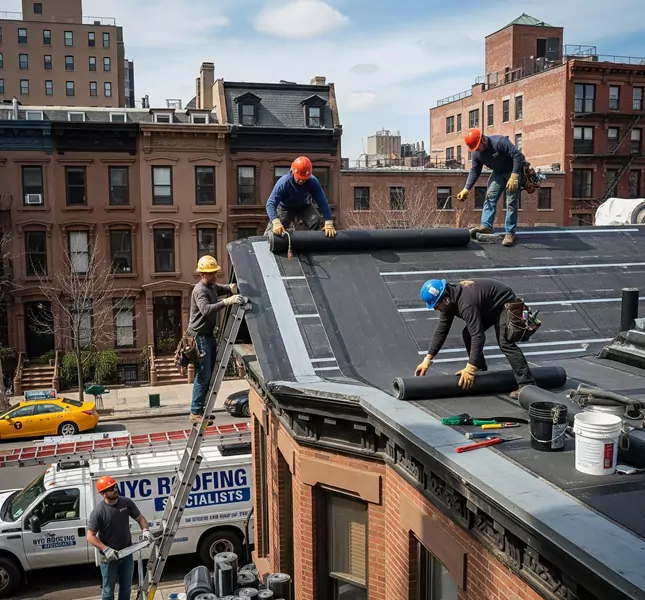
A brownstone roof in Park Slope or Brooklyn Heights is a low-slope membrane deck, walled in by a parapet on three sides and finished at the street with a cornice that is often the most fragile part of the whole building. The field of that roof, the flat middle, is rarely where the water comes in. It comes in at the edges: at the parapet coping, at the joint between the cornice and the roof, and at a drain that has silted up and left the corner of the roof under standing water after every summer storm.
This guide covers how we replace a rowhouse roof in the brownstone belt, from Park Slope and Brooklyn Heights through Cobble Hill, Carroll Gardens and Fort Greene, and what the Landmarks Preservation Commission and your neighbors have to do with it. For the borough as a whole, see our Brooklyn roofing page.
Where a brownstone roof actually leaks
When we survey a Park Slope roof before quoting, we spend most of the time at the perimeter. These are the failure points we find again and again:
- Parapet copings. The stone or metal cap on top of the parapet wall opens at the joints, water gets into the wall, and it shows up inside the house two floors down as a stain on the party wall. The membrane on the roof may be fine.
- Cornice junction. Where the roof meets the back of the front cornice, the flashing is often original or has been tarred over repeatedly. This is the number one source of front-room ceiling leaks on the block.
- Drains and scuppers. A single rear drain serves most rowhouse roofs. When it clogs, the roof ponds against the rear wall, and ponded water finds every weakness in the membrane.
- Bulkhead and skylight curbs. Every vertical surface on the roof needs base flashing and counterflashing that has been maintained. Most have not been.
- Old layers. Many of these roofs have three or four generations of roofing on them. The weight and the trapped moisture between the layers shorten the life of whatever goes on top.
Because the money on a rowhouse roof needs to go to the edges, our quotes for Park Slope and Brooklyn Heights put more of the price in the perimeter and the drainage than in the field. That is where the roof will be won or lost.
Membrane options for a rowhouse
Three low-slope systems cover almost every brownstone roof we replace. Each has a place.
EPDM
EPDM rubber is a single-ply synthetic membrane, fully adhered to the deck or to a cover board. It handles thermal movement well, which matters on a roof that bakes in July and freezes in January, and it is the system we install most on rowhouses with simple geometry. Its weak point is the seams and the details, which is why installation quality matters more than the brand of rubber.
Modified bitumen
Modified bitumen is a multi-ply asphalt system, torch-applied or cold-applied. It is the traditional choice on Brooklyn rowhouses and it is forgiving of a roof with many penetrations, curbs and level changes, because every detail is built up in layers. A granulated cap sheet gives it a finished surface. On an older roof with a bulkhead, several vent pipes and a skylight, it is often the more robust answer.
TPO
TPO is a heat-welded white membrane that reflects heat. It suits a rowhouse with a top-floor apartment that runs hot, and its welded seams are stronger than glued ones. It is less common on individual brownstones than on larger buildings but it is a legitimate choice for the right house.
Whatever the membrane, the parapet gets new base flashing turned up the wall, new counterflashing or a termination bar, and a new coping if the old one is open. The drain gets a new lead or membrane flashing and, where the roof has no slope to it, tapered insulation to move water toward it. That is the difference between a roof replacement and a new membrane laid over the same problems.
Landmarks and the cornice
Park Slope, Brooklyn Heights, Cobble Hill, Carroll Gardens and Fort Greene are all designated historic districts under the Landmarks Preservation Commission. Roofing work that is not visible from the street, which describes most of the membrane itself, generally goes ahead on a DOB permit alone. Anything visible from the street does not: cornice repair or replacement, a change to the parapet coping at the front, a new bulkhead, or a rooftop addition. Those need an LPC permit first, and the commission cares about materials and profile.
In practice this means that when a cornice is part of the leak, we scope the cornice work separately, file it with LPC, and sequence it with the roof so the two are flashed together properly. Trying to fix a cornice leak from the roof side alone, without touching the cornice, is how these buildings end up with a new roof and the same stain. Our permit guide covers the LPC and DOB process in more detail.
Neighbors, party walls and roof access
A rowhouse shares its side walls with the houses on either side, and often shares a parapet with them. Replacing your roof means working at those party walls, and doing it right means the flashing on your side ties into whatever is on your neighbor's side. We notify adjoining owners before we start, we look at the neighboring roof from your side to understand what we are flashing against, and where the neighbor's roof drains onto yours, which happens more than it should, we say so in the estimate.
Access is the other Brooklyn reality. Materials come up through the house or by lift from the street, and the street may need a permit for the lift or the dumpster. We plan that with you before the crew arrives, because a Park Slope block is not somewhere to improvise a delivery.
Drainage and the rear of the house
Most brownstone roofs drain to the rear, through a scupper or a drain into a leader that runs down the back wall. That leader, and any gutter that collects a rear extension roof, is part of the roof's drainage and part of the replacement scope. A new membrane draining into a leader that is split at the elbow puts the water into the rear wall instead of the yard. We check the full path from roof to grade and include what needs replacing.
Getting a roof estimate in Park Slope
REVMA is based in Bayside, Queens and works across the brownstone neighborhoods of Brooklyn. We are licensed and insured, NYC DCWP license 2126882-DCWP, and we install every low-slope system described here. If your roof has been patched more than once and the stains keep coming back, the perimeter is where we will start. Call (646) 889-4529 or request an estimate. If you own a larger multifamily or mixed-use building, our commercial roofing page covers the systems and the process at that scale.