
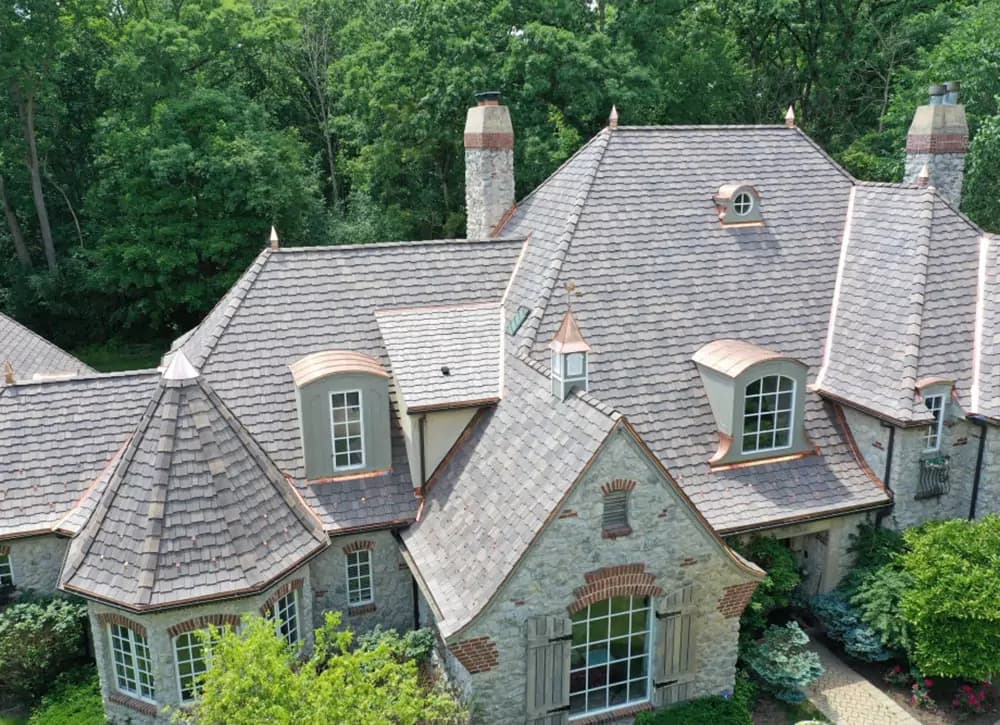
Roof replacement in Great Neck and Manhasset is a different job from a roof in the city, and it pays to understand why before you collect estimates. The homes are larger, the roofs are steeper and more cut up, the permitting runs through individual villages rather than one central department, and the weather comes straight off Long Island Sound. Each of those things changes what a good roof costs, how long it takes, and what it should be made of.
REVMA is based in Bayside, Queens, a short drive over the county line, and the North Shore is where a large share of our cedar, slate and composite work happens. This guide covers what we see on Great Neck and Manhasset roofs and how we approach them.
The housing stock: big roofs with a lot going on
Great Neck, Kings Point, Manhasset, Plandome and Munsey Park hold substantial detached homes: Center-Hall Colonials, Tudors, Dutch Colonials and a good number of larger post-war houses that were built to the same scale. The roof geometry on these homes is the first thing that separates them from a Bayside or Whitestone cape.
- Steep pitches. Many of these roofs are 10/12 or steeper. Steep roofs need staging, roof jacks and more labor per square, and they shed water fast enough that material choice matters less for leaks and more for wind.
- Dormers and valleys. A Tudor with three gabled dormers and two intersecting rooflines has a dozen valleys and a lot of step flashing. On these roofs the detailing is a larger share of the work than the field material.
- Original cedar and slate. A meaningful number of North Shore homes still carry their original cedar shingles or natural slate. Some of that slate is worth restoring. Most of the cedar is at the end of its life.
- Heavy framing, sometimes. Homes built for slate usually have the rafters to carry it again. Homes built for cedar or asphalt usually do not, and that decides whether real slate is even an option.
Choosing a material for a North Shore roof
Because the roofs are large, the material choice genuinely moves the budget. That is not true on a small cape, where labor dominates. Here is how the decision usually goes.
Composite slate and shake
DaVinci and Brava composite is the most common answer we give in Great Neck and Manhasset. It delivers the slate or shake profile the house was designed for, at a fraction of the weight of natural slate, with a Class A fire rating and a Class 4 impact rating. On a house that originally had cedar and whose framing was sized for cedar, composite shake is the way to keep the look without a structural upgrade.
Natural cedar
Western red cedar is the original material on many Colonials here, and homeowners who want the real thing still ask for it. We install Waldun cedar shakes and shingles with copper flashing. Cedar wants ventilation underneath and a roof that dries out between storms, which the exposed North Shore lots generally provide.
Natural slate
If the house has a slate roof now, the question is whether it can be restored rather than replaced. A slate roof with sound slates and failed flashing is a repair, not a tear-off. A slate roof where the slates themselves are delaminating is at the end of its life, and at that point the choice is new Vermont slate or composite. We tell you which one you have before we quote either.
Luxury asphalt
On larger post-war homes with simpler rooflines, a luxury shingle such as CertainTeed Grand Manor gives a dimensional slate look at an asphalt price and weight. It is the practical choice when the roof is big but the architecture does not demand a premium material.
Permitting: there is no single Nassau permit
This surprises homeowners moving out from the city. In Queens, every roof permit goes through the NYC Department of Buildings. In Nassau there is no county building department for residential work. Unincorporated areas of the Town of North Hempstead permit through the town. The incorporated villages, and the North Shore is dense with them, each run their own building department with their own application, fee schedule and inspection process.
Great Neck alone is a patchwork of villages: Great Neck, Great Neck Estates, Great Neck Plaza, Kings Point, Kensington, Saddle Rock, Thomaston and Russell Gardens, among others. Manhasset is largely unincorporated with Plandome, Plandome Manor, Plandome Heights, Munsey Park and Flower Hill as villages inside it. The village you are in determines who you file with and how long it takes.
Many of these villages also apply architectural review to work visible from the street. That can constrain color, profile and material, and it needs to be started early because the review board may only meet monthly. We confirm the requirements for the specific address before we quote, because on the North Shore the lead time varies more than the price does.
Wind off the Sound
Nassau County sits in a higher design wind zone than most of the five boroughs, and the North Shore takes weather directly off Long Island Sound. Kings Point, Sands Point and the waterfront blocks of Great Neck and Port Washington are exposed in a way inland Manhasset is not.
Wind failures on a roof almost always begin at the edge: the starter course, the rake, and the first few courses above the eave. On exposed North Shore roofs we specify higher-wind-rated shingles where asphalt is used, upgrade the perimeter fastening, and run ice and water underlayment well beyond the code minimum at the eaves and in every valley. On composite and cedar, the fastening schedule and the starter detail get the same attention.
The other exposure issue on these lots is the tree canopy. Mature oaks over a roof mean constant leaf load in valleys and gutters, and a clogged valley is the most common source of the slow leaks we get called out to on the North Shore.
Gutters, drip edge and drainage on a large roof
A big steep roof moves a lot of water to the eave quickly, and the gutter system has to keep up. When we replace a roof in Great Neck or Manhasset we treat the roof edge as part of the scope, not an afterthought.
- New drip edge and gutter apron at every eave, so water leaves the deck and enters the gutter rather than running behind it.
- Gutters that are undersized for the roof area, pulling away from the fascia, or pitched wrong are replaced at tear-off, when the edge is open and the work is cheapest to do right.
- Downspouts routed to discharge away from the foundation, which matters on sloped North Shore lots where water otherwise runs straight to the basement.
Replacing gutters as part of the roof project avoids a second contractor working over a brand new roof edge later.
Getting a roof estimate in Great Neck and Manhasset
REVMA is based in Bayside, Queens, minutes from the Nassau line, and we are licensed and insured (2126882-DCWP). We give estimates based on an actual look at the roof, including the attic and the framing, so the material recommendation is one the house can carry. Call (646) 889-4529 or request an estimate online. For the wider picture of how we work across the county, see our Nassau County roofing page, and if you are further east, our guide to roof replacement in Garden City covers the village review process in more detail. Financing is available on complete replacements.