
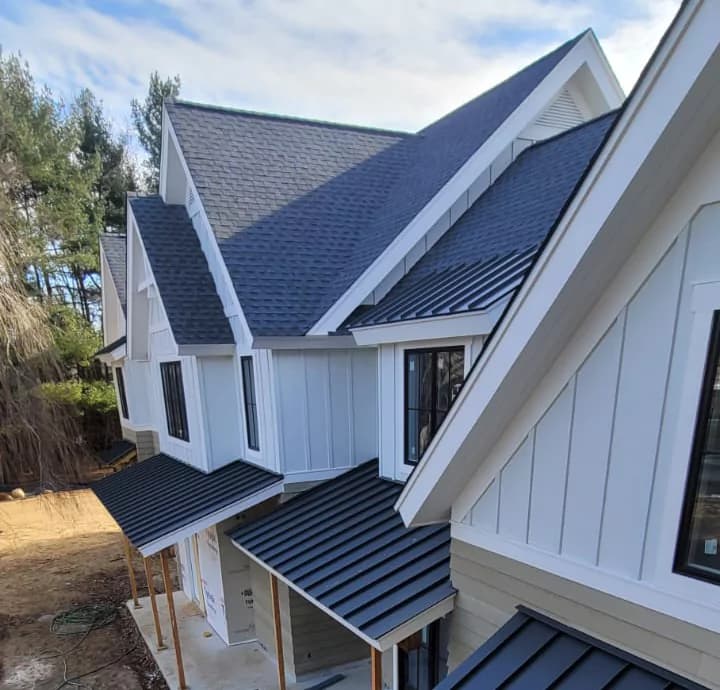
Throgs Neck, Country Club and City Island sit on the piece of the Bronx that sticks out into the water, with the East River on one side and Long Island Sound on the other. A roof here is not the same job as a roof in Morris Park a mile inland. The wind arrives with nothing in its way, the air carries salt, and the edge of the roof is under constant load. Most of the roofs we replace on this waterfront failed at the perimeter, not in the middle.
This guide covers what we specify differently for a coastal Bronx roof, how the attached and detached housing stock changes the work, and what to expect from permitting. For the rest of the borough, start with our Bronx roofing page.
How wind takes a roof apart
Wind does not lift a roof from the center. It gets under the first course at the eave or the rake, peels one tab, and then works up the slope using each lifted shingle as a handle on the next. On a house facing the Sound in Country Club or on the exposed blocks of City Island, that first course is doing more work than any other part of the roof. If the starter strip is missing, the nails are high, or the sealant strip never bonded because the roof went on in cold weather, the roof is one nor'easter from a claim.
Salt makes it worse over time. Galvanized fasteners and flashing corrode faster within sight of the water, and a nail that has lost its head holds nothing. On a coastal replacement we treat fastener and metal choice as part of the wind spec, not as a separate line item.
What we specify on a coastal Bronx roof
The good news is that the shingle industry has already solved this for hurricane markets, and the same details work in the Bronx. On a Throgs Neck or City Island replacement we build the roof to the manufacturer's high-wind installation, which changes several things from a standard job:
- Six nails per shingle instead of four, placed in the nailing zone the manufacturer specifies, not above it.
- A real starter course at both the eaves and the rakes, with the factory sealant strip at the edge, rather than an inverted shingle.
- Ice and water membrane at the eaves, in the valleys and around every penetration. On a windward slope we often extend it further up the roof than code requires.
- Corrosion-resistant fasteners and flashing. Hot-dipped galvanized or stainless nails, and aluminum or copper flashing rather than plain steel.
- Drip edge set tight under the underlayment at the eaves and over it at the rakes, so wind-driven rain cannot get behind the edge.
- Hip and ridge caps from the manufacturer's high-wind line, hand-sealed where the exposure calls for it.
The shingle lines we install most on this waterfront are the GAF Timberline HDZ and Owens Corning Duration families, both of which carry high-wind ratings when installed to their enhanced specification. That rating is only real if the installation matches. A wind warranty on a roof with four nails and no starter strip is a piece of paper.
Two kinds of houses, two kinds of roof
The eastern Bronx puts two building types on the same street, and they need different crews.
Attached and semi-attached brick
Much of Throgs Neck, Country Club and the blocks toward Pelham Bay is attached or semi-attached brick housing from the mid-twentieth century. The front usually has a shallow-pitched shingle roof, and the rear is a low-slope deck that is often shared with the neighbor. Those rear roofs are membrane work, not shingle work, and they are where the ponding and the slow leaks live. We quote the two surfaces separately and we flash the transition between them properly, because the seam where the pitch changes is the most common leak on this housing type. For the low-slope portion see our flat roof page.
Detached wood frame
City Island is largely detached wood-frame houses, many of them older and closer to the water than anything else in the borough. These are full pitched roofs with the exposure of a beach house. Attic ventilation matters more here because the framing is lighter, and the gutter and downspout layout has to move water away from a foundation that is often near grade.
Gutters on a coastal house
Wind-driven rain overwhelms undersized gutters, and salt-air corrosion finishes off the ones that were marginal. When we replace a roof on the waterfront we look at the gutters as part of the roof edge. If they are pulling away, undersized for the roof area, or discharging at the foundation, replacing them with the roof is the efficient moment to do it: the drip edge, gutter apron and hangers all go on in the same sequence. If they are sound, we protect them during the tear-off and tie the new drip edge into them correctly.
After a storm
If a storm has already taken shingles off your roof in Throgs Neck or City Island, the sequence is: keep water out, document everything, then decide on repair or replacement. We tarp exposed decking, photograph the damage from the roof, and put the findings in writing so they can go to an adjuster. Our storm damage page explains the process, and our insurance claims page covers how we work with your carrier. A roof that lost a few tabs on one slope may be a repair. A roof that lost tabs on every slope is telling you that the sealant bond failed across the whole surface, and patching it slope by slope is money spent twice.
Permits and approvals
All of the eastern Bronx is NYC Department of Buildings territory. A full tear-off is filed through DOB NOW with a licensed, insured contractor on record, which we handle. None of these neighborhoods is a Landmarks district, so there is no LPC layer on top. Where a house is attached, we notify the adjoining owner before work at the party wall or shared rear roof begins. Our permit guide covers what gets filed and when.
Getting a roof estimate in Throgs Neck
REVMA is based in Bayside, Queens, directly across the Throgs Neck Bridge from Throgs Neck, Country Club, Pelham Bay and City Island. Our own yard sits on the Little Neck Bay waterfront, so we build every roof in our home market to the same wind details described here. We are licensed and insured, NYC DCWP license 2126882-DCWP. Call (646) 889-4529 or request an estimate, and we will look at the roof, the edges and the rear deck before we put a number in front of you.