
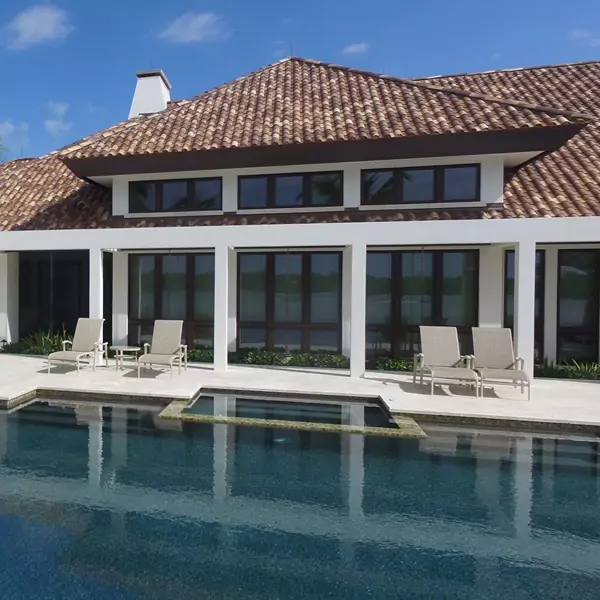
Forest Hills Gardens and Jamaica Estates are the two neighborhoods in central Queens where a roof replacement most often involves clay tile or natural slate rather than asphalt. Both were developed in the early twentieth century as planned residential enclaves, both kept their large houses and their original roofs to an unusual degree, and both have review processes that go beyond a standard Department of Buildings filing. If you own one of these houses, the roof is a bigger decision than it is on most of the borough.
Forest Hills Gardens: a private community with its own review
Forest Hills Gardens was laid out beginning in 1909 as a planned garden community, and it remains privately owned and governed by the Forest Hills Gardens Corporation. The streets are private, the architecture is controlled, and exterior work, including roofing, is subject to the corporation's architectural review in addition to the city permit. That review is stricter than most homeowners expect. The corporation's interest is in keeping the streetscape consistent, and a visible roof material change is exactly the kind of thing it exists to look at.
The houses are Tudor Revival, Arts and Crafts and English cottage styles, and a large number were roofed in clay tile or slate. Where those roofs survive, the expectation from the corporation is generally that a replacement stays consistent with the original. We start the corporation's process before we start the city's, because it is the longer of the two and it determines what the city filing will say.
Jamaica Estates: large lots, big trees, complex roofs
Jamaica Estates, a mile and a half east, was developed from 1907 on a hilly, wooded tract, and it kept the trees. The houses are detached, large, and set back on lots that most of Queens would consider generous. Tudors and Colonials with slate roofs are common, and so are roofs with multiple intersecting gables, long valleys and dormers on more than one elevation.
Jamaica Estates is not a private community and has no landmark district covering the whole neighborhood, so the permit is a standard NYC Department of Buildings filing through DOB NOW. The complication here is not the paperwork. It is the geometry and the trees. A roof with six valleys under a mature oak canopy holds leaf debris in every one of them, and the slow leaks we get called out to in Jamaica Estates are almost always at a valley or at a chimney that the trees keep damp.
Clay tile: replace in kind or not at all
Clay tile is heavy, brittle to walk on and very long lived. A tile roof on a Forest Hills Gardens Tudor is likely to be original, and the tile itself is often in fair condition. What fails is the underlayment beneath it, which was never designed to last a century, and the flashing at the chimneys and walls. A proper tile roof replacement usually means lifting and salvaging the sound tile, replacing the underlayment and flashings, and relaying the original tile with new pieces to fill in breakage. Matching new tile to old is possible, and the profile and color have to be right or the patch shows from the street.
Slate: restore first, replace when it is truly done
The same logic applies to slate. A hundred-year-old slate roof that is shedding a few pieces a year is usually a candidate for restoration: new copper flashings, a rebuilt ridge, and individual slates replaced. It is only when the slate is soft, flaking and failing across whole slopes that a full replacement is the honest recommendation. When it is, the choice is between new natural slate, which is the answer the Forest Hills Gardens review is most likely to accept without comment, and a composite.
Where composite fits
DaVinci and Brava make slate profiles, and Brava also makes a barrel tile that reads as clay from the street. The case for composite on these houses is weight and cost: a composite roof weighs a fraction of tile or slate and can go on framing that was never meant to carry more than it already does. Whether the Forest Hills Gardens Corporation accepts a composite on a particular house is its decision, and it is worth asking before you fall in love with a sample. In Jamaica Estates, where the review is the city's alone, composite is a straightforward option and a common one.
For a homeowner who wants to move to asphalt on a house outside the Gardens, the CertainTeed Grand Manor line is the shingle we recommend most on this kind of architecture, because its profile is heavy enough to sit under a Tudor gable without looking thin.
Details that decide the job
- Flashing. On a tile or slate roof, the metal does the work. Copper or lead-coated copper at every chimney, wall and valley.
- Valleys. Open metal valleys clear leaf debris; closed valleys trap it. On a heavily treed lot we specify open valleys wherever the design allows.
- Access and protection. Tile breaks when walked on. The job is staged so the crew works from ladders and planks, not from the roof surface.
- Gutters. A tile or slate roof sheds water fast and hard. The gutters have to be sized and hung for it, and the fascia behind them is inspected while the eave is open.
Getting a roof estimate in Forest Hills Gardens or Jamaica Estates
REVMA is based in Bayside, Queens, licensed by the NYC Department of Consumer and Worker Protection (2126882-DCWP), and insured. We inspect slate and tile roofs before recommending anything, because most of them do not need replacing yet and we would rather tell you that. Call (646) 889-4529 or request an estimate. Our Queens roofing page covers the rest of the borough, and a professional inspection is the right first step on any roof this old.