
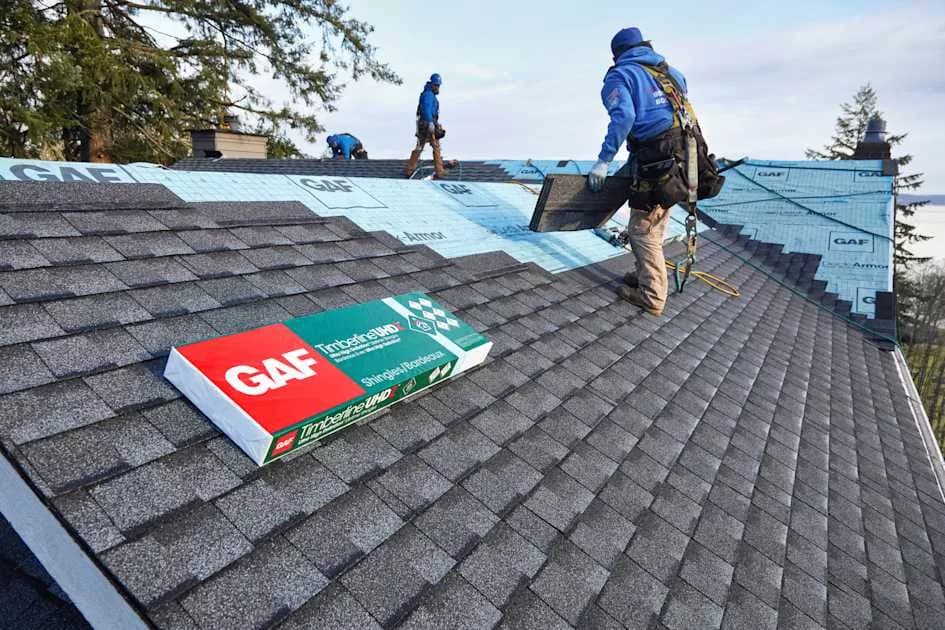
Whitestone and Beechhurst sit on the northern edge of Queens, on a peninsula between the Whitestone Bridge and the Throgs Neck Bridge, with the East River opening into Long Island Sound directly to the north. That geography is the single most important fact about roofing here. Every nor'easter and every summer thunderstorm line arrives across open water, and a roof replacement in Whitestone that ignores the exposure will fail at the edges long before the shingles wear out.
The houses along the water
Malba and Beechhurst hold some of the largest detached homes in Queens, many on generous lots close to the shoreline, with complex roofs, multiple dormers and long rake edges facing the water. Whitestone proper is a mix of 1920s to 1950s Colonials and Capes, semi-detached brick homes on the streets south of 14th Avenue, and a scattering of newer construction on the larger lots. College Point, to the west, adds attached rows and small multifamily buildings with low-slope roofs.
On the waterfront streets the roofs are bigger, the pitches are steeper and the exposure is worse. On the inland blocks the roofs are simpler, but the wind still arrives with less to slow it down than in most of the borough. Either way, the specification has to be written for wind first.
Where wind damage actually starts
A shingle roof does not usually fail in the middle of a slope. It fails at the edge, where wind moving over the roof creates uplift and finds the first loose course. Once the starter course lifts, the field shingles above it lose their seal and the damage moves up the roof with each gust. The fix is not a heavier shingle. The fix is a better edge.
On Whitestone and Beechhurst roofs we build the perimeter as a system:
- Starter strip at every eave and rake. A factory starter with a sealant strip, not a cut-down field shingle turned upside down.
- Drip edge fastened through the deck. The metal edge is the anchor for the whole starter course. It gets nailed to the sheathing on a tight spacing, and the underlayment laps over it at the eave and under it at the rake so water has one direction to go.
- High-wind nailing on the first courses. The manufacturer's enhanced nailing pattern, six nails per shingle where the product allows it, on the courses nearest the edge.
- Ice and water membrane at the eaves and valleys. Waterfront wind drives rain and snow uphill under the shingles. A self-adhered membrane at every eave, valley and penetration is the backup for the day the wind wins.
The shingles themselves matter too. The architectural lines we install, GAF Timberline HDZ and Owens Corning Duration, carry enhanced wind warranties that apply only when the installation follows the manufacturer's high-wind requirements. We install to that standard on every waterfront job because the warranty is worth nothing otherwise.
Permits and what the city expects
Whitestone and Beechhurst are New York City, so a full replacement is filed with the Department of Buildings through DOB NOW, with a licensed and insured contractor on record. There are no landmark districts on the peninsula that affect routine roofing, so the process is the standard one. We file it. You should never be asked to pull your own permit for a roof replacement, and if you are, ask why the contractor cannot.
Materials beyond asphalt
The larger Malba and Beechhurst homes are where we install more than shingles. Slate and cedar both appear as original material on the older houses, and both handle wind well when they are installed and fastened correctly. Where a homeowner wants the look without the weight, composite slate and shake from DaVinci and Brava carry high wind and impact ratings and are a common choice on these roofs. On the flat and low-slope roofs in College Point, the answer is a membrane system, and our flat roof page covers the options.
After the storm
If a storm has already found the weak edge on your roof, the sequence is simple. Get the roof dried in, document the damage, and decide whether the roof is worth repairing or has reached the point where a replacement is the better spend. We handle storm damage roof replacement and the insurance claim that usually goes with it, including the documentation the adjuster wants to see. If the damage is limited to a few courses on one slope, repair is often the honest answer, and we will say so.
Gutters and drainage on a windy roof
Wind-driven rain overwhelms undersized gutters, and the same gusts that lift shingles also pull loose gutter hangers off the fascia. When we replace a roof in Whitestone we look at the gutters as part of the scope: the drip edge is set to feed the gutter properly, damaged fascia behind the gutter is replaced while the roof edge is open, and if the gutters are at the end of their life we replace them at the same time rather than hanging old gutters on new fascia. It is cheaper to do it once.
Getting a roof estimate in Whitestone
REVMA is based on 23rd Avenue in Bayside, a few minutes from Whitestone, and we work the peninsula from Malba to College Point. We are licensed by the NYC Department of Consumer and Worker Protection (2126882-DCWP) and insured, and we price every roof after looking at it in person. Call (646) 889-4529 or request an estimate. For the rest of the borough, see our Queens roofing page.