
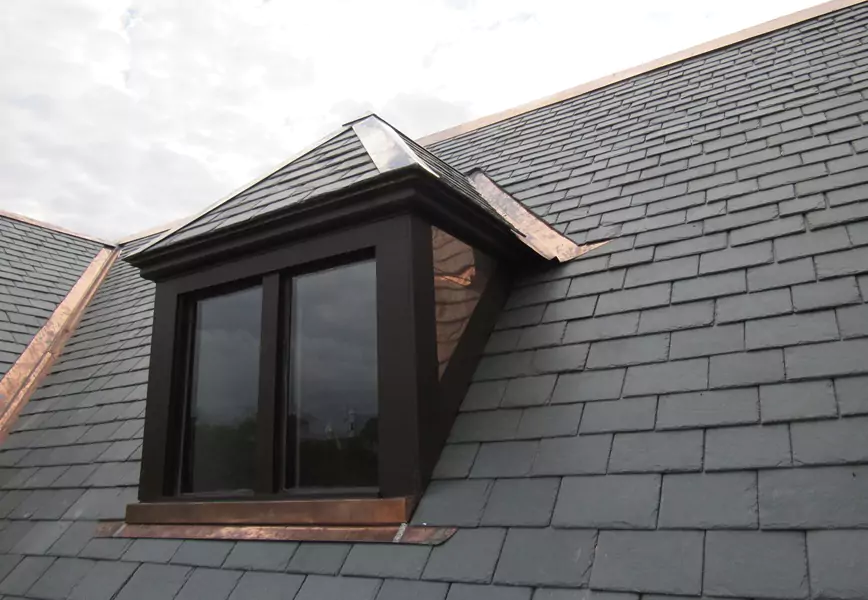
Riverdale and Fieldston are where the Bronx keeps its slate. The Tudors, Colonials and stone-fronted houses built through the 1920s and 1930s along the ridge above the Hudson were roofed in natural slate and clay tile, and a large share of them still carry that original material a century later. If you own one of these houses, the question is rarely whether the roof is old. It is whether the roof is finished, and what to put on it if it is.
This guide covers how we approach a slate or tile roof in Riverdale, Fieldston, Spuyten Duyvil and Kingsbridge: how to tell repair from replacement, what the Landmarks Preservation Commission requires in the Fieldston historic district, and where natural slate still makes sense against the composite alternatives. For the wider borough, see our Bronx roofing page.
Why these roofs last, and why they still fail
Natural slate does not wear out the way asphalt does. A sound piece of hard slate is essentially the same rock it was when it went up. What fails on a slate roof in Riverdale is almost always something other than the slate itself:
- Fasteners. Original slates were hung on iron or steel nails. Once those rust through, slates slide out one at a time, which is why you see a few missing pieces on the north slope every spring.
- Flashing. Valleys, chimney saddles and step flashing were often done in terne or galvanized steel with a shorter life than the slate around them. Most leaks on a slate roof come in at the metal, not the stone.
- Soft slate. Some Pennsylvania slates delaminate and go soft after 70 to 90 years. When a slate flakes at the edges and crumbles when tapped, the roof is at the end of its service life regardless of how it looks from the street.
- Prior repairs. A slate roof that has been tarred or patched with asphalt shingles over the years has usually had its drainage disrupted, and those patches are where water now gets in.
The distinction matters because a roof with sound hard slate and failed flashing is a restoration job, not a replacement. Tearing off good Vermont slate to install something cheaper is a loss for the house and the owner.
Repair, restore or replace
We look at three things before we quote a Riverdale slate roof. The first is the hardness of the slate, tested by tapping and by checking the edges of a few pieces from the roof itself. The second is the state of the flashing and the deck beneath the slate. The third is how much of the roof has already been disturbed by past work.
Repair
A handful of slipped or broken slates on an otherwise sound roof is a repair. We hook new matching slates in place and leave the rest alone. This is routine and does not need a permit.
Restore
When the slate is hard but the flashing and fasteners are done, the right answer is often to strip the slate carefully, save the sound pieces, replace the underlayment and flashing in copper, and re-lay the original slate with new copper nails. Broken and soft pieces are replaced with matching new slate. The house keeps its roof, and the roof gets another long run.
Replace
If the slate itself has gone soft, or if the roof has been patched so many times that it no longer sheds water as a system, replacement is the honest recommendation. At that point you choose the material for the next century.
Choosing the material for a Riverdale house
On a pre-war house in this part of the Bronx, the material has to answer to the architecture, the framing and the budget, in that order.
Natural slate from Vermont is the reference material. It matches what was there, it is what the neighbors have, and on a house that will stand another hundred years it is the roof that costs the least over that span. It is also heavy, so we check that the rafters and the deck were built for it. On a house that had slate originally, they were.
Composite slate from DaVinci or Brava is what we recommend when the framing has been altered, when an addition was built for asphalt, or when the budget will not stretch to natural stone. Modern composite profiles read as slate from the sidewalk, carry Class A fire and Class 4 impact ratings, and weigh a fraction of the real thing. On a Fieldston house, the choice between the two usually comes down to what the Landmarks Preservation Commission will accept for that specific facade.
Clay tile on a Spanish or Mediterranean style house is a different conversation. Tile roofs in Riverdale are less common than slate but they exist, and they follow the same rule: the tile usually outlasts everything underneath it.
Landmarks review in Fieldston
Fieldston is a designated historic district under the New York City Landmarks Preservation Commission. That has a practical effect on roofing. Any change to a roof that is visible from a public street, including a change of material, color or profile, needs an LPC permit before the Department of Buildings will sign off. In-kind replacement of slate with matching slate is the most straightforward approval. Substituting a composite product is possible but the commission reviews it, and the lead time on that review has to be built into the schedule.
The rest of Riverdale, along with Spuyten Duyvil and Kingsbridge, is outside the district, so a roof there goes straight to DOB. Either way we handle the filing. We have written up the whole process, including how NYC differs from Nassau and Westchester, in our guide to roof replacement permits.
What a full slate job includes
When we replace or restore a slate roof in Riverdale the scope goes well beyond the slate:
- Full tear-off to the deck, with rotten boards replaced. Many of these houses have skip-sheathed or plank decks that need attention.
- Ice and water membrane at eaves, valleys and every penetration, with a breathable underlayment over the field.
- Copper valleys, step flashing, counterflashing at chimneys and copper drip edge. On a hundred-year roof the metal has to last as long as the stone.
- Snow guards on the slopes above entrances and walkways. Slate sheds snow in sheets.
- Gutters and downspouts. Original half-round copper gutters are worth keeping if they are sound. If the house has been fitted with aluminum gutters that are pulling away, replacing them at the same time as the roof is the cheapest moment to do it, because the drip edge and the gutter apron get installed together.
Ventilation is the last item. Pre-war attics were often unventilated and the house managed anyway. Once you add insulation, which most Riverdale owners have, the attic needs to breathe or the deck will suffer. We size ridge and soffit ventilation as part of the roof, not as an afterthought.
Getting a roof estimate in Riverdale
REVMA is based in Bayside, Queens, a short run across the Whitestone Bridge from Riverdale, Fieldston and Kingsbridge. We are licensed and insured, NYC DCWP Home Improvement Contractor license 2126882-DCWP, and slate is one of the roofs we install most across the Westchester and Bronx markets. If you are looking at a slate roof and are not sure whether it is a repair or a replacement, we will tell you plainly after we have been on it, and put the reasoning in writing. Call (646) 889-4529 or request an estimate and we will schedule a look.